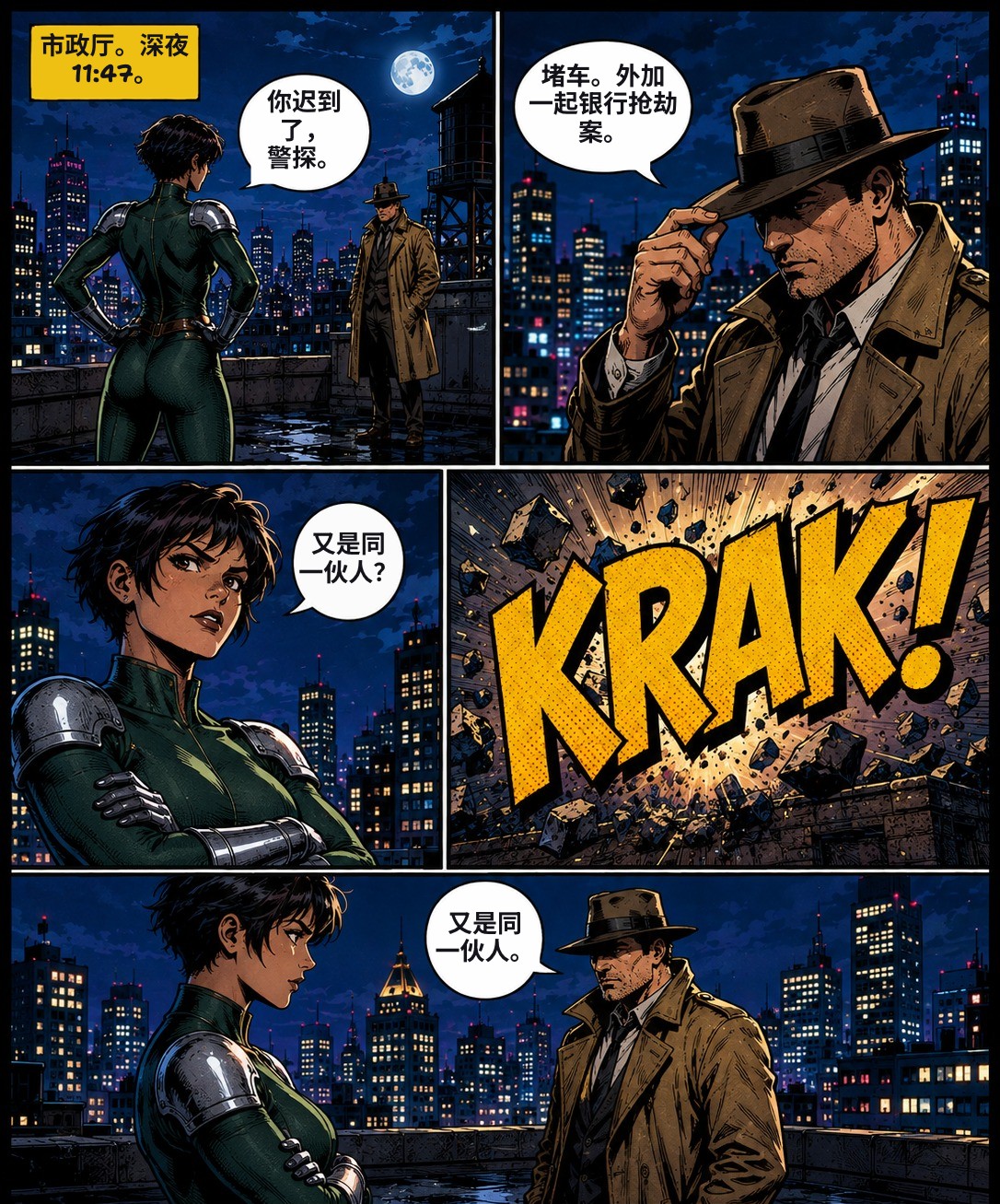
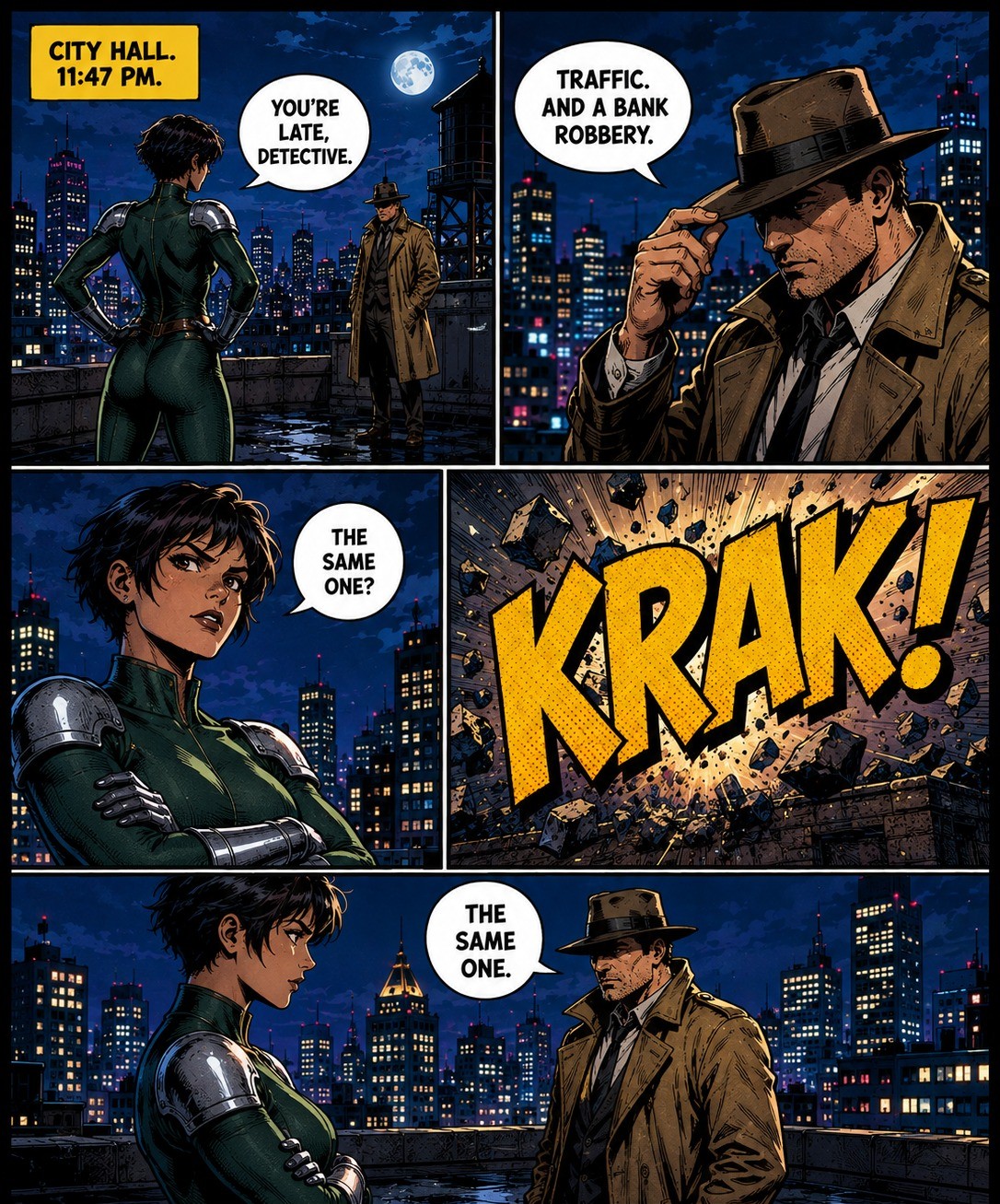

JPG · PNG · WEBP · PDF · CBZ · CBR — up to 20 MB
English · French · Spanish · Italian · Chinese → 30+ languages. Reading order and lettering style detected per page.
Translate comic pages, a BD album or a manhua chapter and get them back lettered — balloons redrawn, captions refitted, sound effects handled. Not a wall of subtitles pasted over the art.


English · French · Spanish · Italian · Chinese → 30+ languages. Reading order and lettering style detected per page.
Four things that change once the page stops being Japanese.
Western comics and BD read the opposite way from manga. Panel order is detected per page, not assumed from a global setting.
A BD page has fewer, wider panels and far more caption text than a manga page. Line-breaking and font sizing are tuned for that, not for a narrow tategaki bubble.
Comic lettering is traditionally all-caps in a hand-lettered face. We match the register instead of dropping sentence-case text into a balloon and calling it done.
Narration boxes, sound effects drawn into the art and text on in-world signs are three different jobs. Each gets handled as its own kind of text.
Large-format pages, dense narration, and a French-to-English gap that Google Translate flattens badly.
Often long-strip like manhwa — handled by the webtoon translator path automatically.
Creators localising their own work: run the issue once per language and export a CBZ each time. Commercial use is included on Pro and Studio.
Three steps. No account needed to try it.
Drop a single page, a folder, a CBZ archive or a PDF. Reading order is detected from the layout, and you can flip it before the run if a page was drawn right-to-left.
The whole page is translated as one piece, so a caption that continues into the next panel stays one sentence instead of two disconnected fragments.
Balloons are repainted with the translation lettered inside them. Export back to CBZ or PDF and open it in whatever reader you already use.
Screenshot translators and OCR apps were built for menus and documents. A comic page breaks most of their assumptions.
Four situations that come up most often.
A series that never got an official release in your language, or one where the official version is years behind the original. Translate the issue you are on and keep reading.
You own the pages, so there is nothing to argue about. Run the whole issue as a chapter, draw a box over anything the model missed, and export a CBZ per language.
BD narration carries register and idiom that word-level machine translation flattens. A whole-page pass keeps the voice closer to the original.
Read the original next to the translation. Comics are one of the few places where you get natural spoken register with visual context attached.
Three sample pages are built in, or drop your own. 3 pages a day are free and no account is needed.
The details that decide whether a translated page is readable or just technically translated.
Every balloon gets its own font size, worked out from the space actually available, and lines are broken to fit the balloon.
Reading order is detected per page and defaults to left-to-right here; flip it before the run for a page drawn the other way.
Repainting is confined to the inside of the balloon. The outline, the tail and the art around it are untouched.
Sound effects drawn into the artwork are redrawn where they sit, with an outline, instead of being dropped.
The output opens in Panels, YACReader, Tachiyomi, Mihon or anything else that reads standard archives.
Draw a box over anything the model missed and it reads just that region — one credit, merged into the page instead of a full re-run.
Source languages are detected automatically. Target languages below.
Yes. Panel order, balloon shapes and lettering style are detected per page, so a Marvel-format page and a tankōbon page are handled differently.
CBZ and PDF in, CBZ out. CBR (RAR) works too but converts to CBZ on export.
Supported — and it's one of the cases where an LLM translator is clearly better than Google Translate, because BD narration carries register and idiom that word-level MT flattens.
That's the use we like most. Run the whole issue through the chapter translator, then fix any balloon the model missed by drawing a box over it. Commercial use is included on Pro and Studio.
200 per run on a paid plan, 10 on the free tier. A standard US comic issue is 20–24 pages, so an issue fits comfortably in one run.
Yes. Reading order is worked out from the layout rather than assumed, and you can override it before the run if a page is unusual.
Effects drawn into the artwork are redrawn in place with an outline, so they stay part of the picture. Effects inside a balloon are treated as dialogue.
Treat the automatic pass as a solid first draft. For anything you are putting your name on, run it and then go through the lettering yourself — that is how professional localisation works with any tool.
No. Pages are processed and discarded; only the job metadata (page count, language, timing) is stored so your credit balance adds up.